
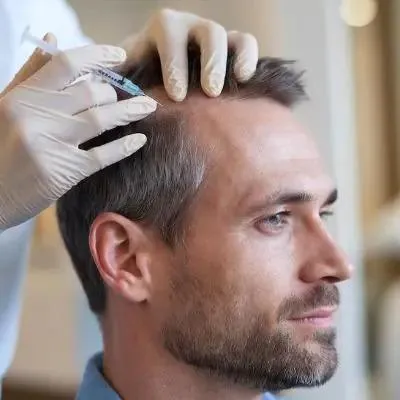
What causes it
Androgenetic alopecia is driven by genetics and the hormone dihydrotestosterone (DHT). In susceptible follicles, DHT shortens the growth phase and gradually miniaturises the hair until it stops producing a visible strand. It usually starts at the temples and crown and follows a predictable pattern, graded on the Norwood scale.
Treatment options
| Option | Role | Notes |
|---|---|---|
| Finasteride / dutasteride (prescription) | Reduces DHT; slows progression | Needs medical supervision; discuss side effects |
| Minoxidil (topical/oral) | Prolongs growth phase | Ongoing use required |
| PRP | Regenerative support | Series of sessions |
| Exosome therapy | Regenerative support | Newer; fewer sessions; higher product cost |
| Hair transplant | Restores coverage in bald areas | Surgical; for established loss |
| Low-level laser therapy | Adjunct | Modest evidence |
Where exosome therapy fits
Exosome hair treatment is most often discussed for men in the earlier stages who still have miniaturised hair in the thinning zones. It is usually positioned alongside medication rather than instead of it, because medication addresses the DHT driver while regenerative injections support the follicle environment. For men with clear bald areas, a transplant conversation is generally more appropriate. See the candidacy checklist.
What a consultation involves
At Estheticare Clinic in F-7/2 Islamabad, a doctor will grade your pattern, examine the scalp, discuss your history and goals, and set out the options with honest expectations. Because the clinic offers medication, PRP, exosomes and transplant, the recommendation can be based on what fits you. We arrange the appointment and are not involved in your care.
Last reviewed: 2026-09-24. This article is general information and not medical advice. Suitability for any treatment must be assessed by a qualified doctor at Estheticare Clinic. Individual results vary.